Baudolino
Book Review (Umberto Eco)

One of the few upsides of being sick for a couple of days is that I feel justified in not doing ‘work’ and instead reading fiction. That’s what enabled me to finish reading Baudolino, which I had picked up over the summer holiday and got hooked on.
If there are two literary authors I’m willing to read over and over, it’s Camus and Eco. I think I’ve read all of Eco’s novels, and many of them more than once. My favourite will always be Name of the Rose, his first and most famous.
But let’s talk about Baudolino. (All?) Eco’s novels tend to do the same thing, in that they mix a bit of detective fiction, alongside conspiracy-theory-thinking, historical worlds mixed with the almost fantastical, very high level in-character-discussion of philosophy and theology, and a recurrent interest in the relationship between signs and signified, truth and fiction; oh, and comedy.
That’s probably why I enjoy them so much. So rich in these things. In the case of Baudolino, we are introduced to the main character (Baudolino, of course) as a liar, an inventor of tales. Baudolino is there, rescuing Niketas, a high government official, during the sack of Constantinople in 1204. Baudolino tells us (and Niketas) just so much - that he is a notorious teller of lies, weaver of stories, and then proceeds to tell us his story. How can we trust that any of it is true?
Of course, the story that follows interweaves with true history, or at least true history as we know it. Baudolino becomes attached to Frederick I Barbarossa, Holy Roman Emperor, and goes on his own adventures across France, Italy, and into the East. Within those stories, Baudolino is also inventing stories. Notably, the letter from Prester John.
Prester John, if you don’t know, was a mythical Christian king and priest who ruled lands far to the East, in opulence and peace. There is a real (fake, forged) letter from Prester John to the Byzantine Emperor, and so indeed Eco is playing off real history to create fake history, but that is part of the point.
One thing I love is how one of Anselm’s proofs for God, that he is “that than which nothing greater can be conceived” is applied by Baudolino and his friends to Prester John’s kingdom - it must exist because it is imagined to exist, and so it must be imagined to be the best in every way, so that it must exist.
Over the course of the novel, Baudolino’s involvement turns eastward. In the end, he accompanies Frederick on Crusade to the Holy Land, and there Frederick dies. This begins the real whodunnit part of the story, since Frederick dies in mysterious circumstances, and amidst mechanical wonders and conflicting stories. The novel then turns further eastward, and draws upon travelogue literature, not least the Romance of Alexander, as Baudolino and companions travel to a mythical far east in search of Prester John’s kingdom.
The novel concludes, mostly, with Baudolino’s return west, to Constantinople, the wrapping up of loose ends, the solving of the mysterious murder, and a denouement. But of course, the question always lingers, what’s true, and what does it matter? Eco is a thorough-going post-modernist, and I love him for it. The past might be a foreign country, and Eco takes us there, but both his story, and Baudolino’s, and all our stories, are beautiful fictions. Just as we are treated within the novel to multiple accounts of Frederick’s death, unable to discern which is a true account, each more plausible than the last, each an explanation fit to the facts, so too the past is a country we construct from our stories, to fit our present.
One of the things I have appreciated about Eco is something that has grown over the years, as I’ve come to know the sources he plumbs and utilises. Perhaps that’s more apparent in Name of the Rose, his most famous novel. I’m sure I read it first in my early 20s, and saw the film version with Sean Connery. But as I’ve re-read it over the years, and become a Latinist, and conversant with medieval theology, I appreciate all the more the in-character discussions. This was brought home on my most recent reading, when the discussions about Jesus’ poverty, and the medieval distinction between the possession of a thing and the possession of use of a thing were things I had read in Aquinas a short time earlier.
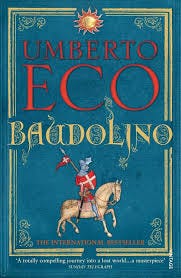
So, too, in Baudolino. My knowledge of medieval history, theology, and ancient travelogue literature has all grown immensely over the years, and so Eco’s foreign country of the fabled past has also grown more familiar, and thus more fun to visit.
Baudolino as a character struggles to disentangle what he sees and what he wants to see, what he believes to be true and what he wants to be true, and what others want to be true he often makes true. As much as this is about postmodernity and narratology, it’s also psychological. We narrate ourselves into a story of ourselves, give meaning and retell stories until they become truer. It’s also about our stories writ large. Sometimes fiction is true, and history a kind of lie. Baudolino is a playful novel that (re)minds us of the (inevitable) gap between the sign and the signified.
“It was a beautiful story. Too bad no one will find out about it.”
“You surely don’t believe you’re the only writer of stories in this world. Sooner or later, someone— a greater liar than Baudolino—will tell it.